
The Irish Roots of American Whiskey: A Story Worth Raising a Glass to on St. Patrick’s Day
Introduction: A Whiskey Story That Crossed the Atlantic
Every March, St. Patrick’s Day brings a wave of Irish pride to cities across the United States. Parades fill the streets, pubs pour plenty of Irish whiskey, and people raise a glass to Ireland’s culture and history. What often gets overlooked, though, is how deeply Irish influence is woven into American whiskey itself.
Long before bourbon and Tennessee whiskey became global icons, distilling traditions were already well established in Ireland and Scotland. The word “whiskey” comes from the Gaelic phrase uisce beatha, meaning “water of life,” a term used for distilled spirits for centuries. When waves of Scots-Irish immigrants began arriving in North America during the 1700s, they brought those distilling traditions with them. Many settled along the Appalachian frontier, in places like Pennsylvania, Virginia, and eventually Kentucky and Tennessee.
Out on the frontier, whiskey quickly became more than just a drink. Farmers often had excess grain, and turning it into whiskey made it easier to store, transport, and sell. Small stills became a common sight in rural communities, and distilling became part of everyday life. Over time, those early whiskey traditions evolved into distinct American styles. Rye whiskey became popular in Pennsylvania and Maryland, while corn-based spirits developed into what we now recognize as bourbon and Tennessee whiskey.
The story of American whiskey didn’t start in Kentucky or Tennessee—it began much earlier, carried across the Atlantic by immigrants who brought their skills, tools, and traditions with them. St. Patrick’s Day offers a good reminder of that connection. When you raise a glass of American whiskey today, you’re also raising a toast to the Irish roots that helped shape it.
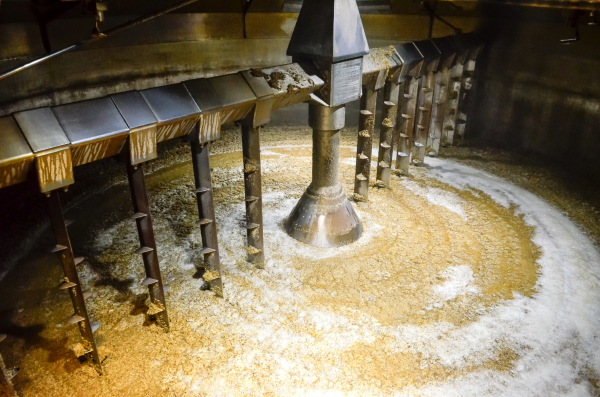
Whisky grain mash.
What Is Whiskey? A Quick Definition
Before diving further into the history, it helps to clarify what whiskey actually is. At its core, whiskey is a distilled spirit made from fermented grain mash. The specific grains can vary—corn, rye, barley, and wheat are the most common—but the basic process remains the same: grain is fermented into alcohol, distilled to increase its strength, and typically aged in wooden barrels to develop flavor.
While the category is broad, most whiskey styles share a few defining characteristics. First, the spirit begins with grain rather than fruit or sugarcane. Second, it goes through a distillation process that concentrates the alcohol. Finally, many whiskeys are aged in oak barrels, which contribute color, aroma, and complexity over time.
Early Irish Distilling Traditions
To understand how whiskey became part of American culture, it helps to look at how the spirit developed in Ireland long before it reached North America.
Distillation itself likely arrived in Europe through knowledge passed along from the Middle East during the medieval period. Early forms of distillation were used primarily for medicine and perfumes, but the technique eventually found its way into producing drinkable spirits. By the late Middle Ages, distilling grain-based alcohol had become increasingly common in Ireland and Scotland.
One of the earliest recorded references to Irish whiskey appears in the Annals of Clonmacnoise, which describe the death of a chieftain in 1405 after drinking excessive uisce beatha. While the account is brief, historians often cite it as evidence that distilled spirits were already present in Ireland by the early 15th century.
The phrase uisce beatha, meaning “water of life,” is where the modern word whiskey comes from. Over time, English speakers adapted the Gaelic term into “usquebaugh,” and eventually shortened it further to “whiskey.” Ireland maintained the spelling with an “e,” while Scotland eventually adopted the shorter version, “whisky.” Both styles, however, share the same linguistic origin.
During the 1500s and 1600s, whiskey production in Ireland expanded significantly. Distilling was not limited to large producers. Farmers, monks, and small community distillers all contributed to the spread of the practice. Whiskey was often made in relatively small copper pot stills, which allowed rural producers to distill grain grown on their own land.
By the 17th century, whiskey had become a widely consumed spirit across Ireland. In fact, Irish whiskey developed a reputation for quality throughout Europe. Some historical accounts suggest that Irish distillers were exporting spirits abroad as early as the 1600s, helping establish whiskey as one of Ireland’s most recognizable products.
The Scots-Irish Migration to America
By the early 1700s, large numbers of immigrants from the border regions of Scotland and northern Ireland began making their way to the American colonies. These settlers are commonly referred to as the Scots-Irish (or Ulster Scots). Many were descendants of Scottish families who had been living in Northern Ireland for generations before economic pressures, land issues, and religious tensions pushed them to seek new opportunities across the Atlantic.

A political cartoon from the 1870s portrays Irish men, women, and even young children drinking whiskey. Image courtesy of the Library of Congress.
Between roughly 1717 and the start of the American Revolution, historians estimate that hundreds of thousands of Scots-Irish immigrants arrived in North America. Many entered through ports like Philadelphia before moving inland in search of affordable land. Over time, they settled heavily throughout the Appalachian frontier, including areas of present-day Pennsylvania, Virginia, North Carolina, Kentucky, and Tennessee.
These communities brought a range of traditions with them—language, music, farming techniques, and foodways. Distilling was one of those traditions. While whiskey production wasn’t unique to the Scots-Irish, many immigrants were already familiar with the process and understood how to build and operate small copper pot stills. On the frontier, that knowledge proved especially useful.
Grain farming was common in early American settlements, but transporting raw grain to market could be difficult. Roads were poor, distances were long, and bulky crops were hard to move. Turning grain into whiskey solved several problems at once. Distillation concentrated the value of the harvest into a smaller, more stable product that could be stored longer and traded more easily.
As Scots-Irish settlers moved deeper into the Appalachian backcountry, whiskey production followed. Small distilleries and farm stills became common throughout the region. In places like western Pennsylvania and the Shenandoah Valley, whiskey quickly became both a household staple and an important economic product.
This frontier whiskey culture laid the groundwork for what would eventually become the American whiskey industry. The same migration routes that carried Scots-Irish settlers into Kentucky and Tennessee would later shape the regions most closely associated with bourbon and Tennessee whiskey today.
The Birth of American Whiskey
As Scots-Irish settlers spread across the Appalachian frontier during the 1700s, whiskey production became a practical part of everyday life. Distilling wasn’t just about making a drink—it was a way to make the most of a harvest.
Grain farming was common throughout the colonies, especially in regions like Pennsylvania and Maryland. Farmers often grew rye, barley, wheat, and corn, but transporting large amounts of grain to distant markets could be difficult. Roads were rough, wagons were slow, and crops were bulky. Converting that grain into whiskey made it easier to store, transport, and trade. A few bushels of grain could be distilled into a product that was far more compact and valuable.
Because of this, small farm distilleries became common throughout rural communities. Many farmers owned simple copper pot stills and produced whiskey during the months when they weren’t planting or harvesting crops. Whiskey was used for trade, for personal consumption, and sometimes even as a form of payment.
Different regions began to develop their own whiskey styles based largely on the grains available locally. In Pennsylvania and parts of Maryland, rye grew well in the cooler climate, which helped establish rye whiskey as one of the earliest American whiskey styles. Rye-based spirits became especially popular in the late 1700s and early 1800s, and the region was home to hundreds of small distilleries.
Further south and west, distillers began working with a different grain. Corn grew easily in Kentucky and Tennessee, and over time it became the primary ingredient in many frontier whiskeys. That shift toward corn would eventually lead to the development of bourbon and other American whiskey styles that remain popular today.
By the end of the 18th century, whiskey had become deeply embedded in the American economy. In some frontier communities, it functioned almost like currency. Barrels of whiskey could be traded for goods, services, and supplies, making it one of the most practical and valuable products farmers could produce.
That importance didn’t go unnoticed by the new federal government—and it would soon lead to one of the earliest conflicts between American farmers and federal tax policy.
The Whiskey Rebellion and America’s Early Whiskey Economy
Recognizing whiskey’s importance, the newly formed federal government sought to tax distilled spirits in 1791 as a way to help pay off debts from the Revolutionary War. The whiskey excise tax was met with immediate resistance. Frontier farmers felt the tax unfairly targeted small-scale distillers while wealthier merchants were better able to absorb it.
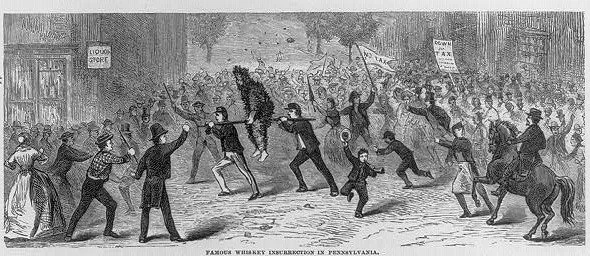
Depiction of the Whiskey Rebellion, courtesy Library of Congress.
Tensions escalated in western Pennsylvania, where farmers organized protests, refused to pay, and in some cases, confronted federal tax collectors. By 1794, the situation had become serious enough that President George Washington personally led a militia force to suppress what became known as the Whiskey Rebellion. While the rebellion was ultimately quelled without large-scale violence, it highlighted both the economic significance of whiskey and the determination of frontier communities to defend their livelihoods.
The Whiskey Rebellion also underscored the role of whiskey in shaping early American identity. It wasn’t just a beverage; it was a symbol of independence, self-sufficiency, and resistance to policies perceived as unjust. The event reinforced the link between distilling, rural economies, and the cultural practices brought over by Irish and Scots-Irish settlers.
By the end of the 18th century, these frontier distilling traditions had taken firm root in the colonies. Small stills and local production methods persisted, setting the stage for the emergence of distinctive regional styles, including the corn-based whiskeys of Kentucky and Tennessee that would define American spirits in the 19th century.
From Frontier Whiskey to Bourbon and Tennessee Whiskey
As settlers pushed further west and south, whiskey production followed. The combination of fertile soil, abundant corn, and Scots-Irish distilling knowledge created the perfect conditions for a new American style: bourbon. In the late 18th century, Kentucky and surrounding areas became the heart of this development. Corn, which thrived in the region’s climate, gradually replaced rye as the primary grain in many recipes, giving these whiskeys a sweeter, fuller-bodied flavor that distinguished them from earlier frontier ryes.
Meanwhile, just across the border in Tennessee, distillers adapted these techniques to local conditions. A signature innovation was the Lincoln County Process, where whiskey is filtered through sugar maple charcoal before aging. This step mellows the spirit and adds a unique character, helping define what we now know as Tennessee whiskey. Notably, the techniques and traditions passed down from Irish and Scots-Irish immigrants were a direct influence on both bourbon and Tennessee whiskey production.
Figures like Jack Daniel and Nathan 'Nearest' Green built on this heritage. Daniel’s distillery, founded in the late 19th century, incorporated the charcoal filtering method, while Green, one of the first African-American master distillers, helped teach these techniques and mentor future generations. Their work illustrates how early distilling knowledge—rooted in European, and particularly Irish, traditions—continued to evolve in America.
By the 19th century, whiskey had transformed from a practical frontier commodity into a distinct product with regional identity. Rye whiskey, bourbon, and Tennessee whiskey each carried the mark of local ingredients, immigrant know-how, and cultural adaptation. The legacy of Irish and Scots-Irish settlers remained embedded in the production methods, flavor profiles, and even the social role whiskey played in American communities.
Why St. Patrick’s Day and Whiskey Go Hand in Hand
By now, it’s clear that Irish influence runs deep in American whiskey—but why does that connection feel especially strong around St. Patrick’s Day? The holiday, celebrated globally on March 17, has long been associated with Irish culture, music, and food. Whiskey, as Ireland’s most famous export, naturally became part of the celebration.
In Ireland, whiskey has been enjoyed for centuries not just as a beverage, but as a part of social gatherings and community life. When Irish and Scots-Irish immigrants brought their distilling knowledge to America, they also brought these cultural practices. The traditions of sharing a dram, toasting friends and family, and honoring milestones became embedded in frontier communities alongside the practical uses of whiskey.
For Americans, St. Patrick’s Day has evolved into a celebration that includes both Irish heritage and the legacy of Irish influence on American life. That’s why toasting with whiskey—whether it’s Irish, rye, bourbon, or Tennessee whiskey—is more than just a drink choice. It’s a nod to the centuries-old connection between Ireland and the United States, a connection that helped shape not only a spirit but also the culture surrounding it.
So this St. Patrick’s Day, raising a glass of whiskey is more than a festive gesture. It’s a toast to the traditions that traveled across the Atlantic, to the ingenuity of early settlers, and to a shared heritage that still flavors every sip of American whiskey today.
The Legacy of Irish Influence on American Distilling
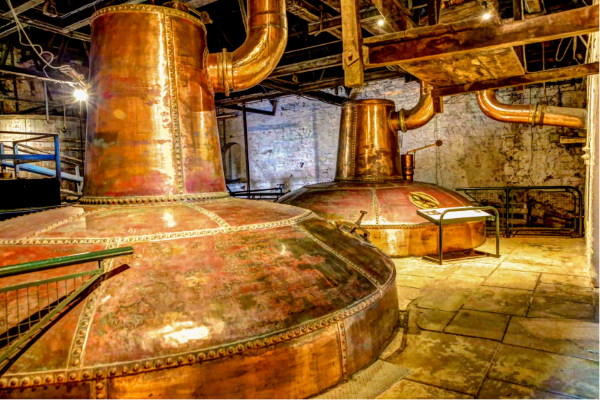
Copper pot still at a distillery in Ireland.
The impact of Irish and Scots-Irish immigrants on American whiskey didn’t stop at the frontier. Their techniques, knowledge, and approach to distilling created a foundation that continues to shape American spirits today. From the early copper pot stills to the adoption of the Lincoln County Process in Tennessee, much of what makes American whiskey distinct can trace its roots back to these early settlers.
Even as the whiskey industry industrialized in the 19th and 20th centuries, the principles brought over by Irish immigrants remained central: attention to grain selection, careful distillation, and the importance of aging in barrels. Craft distillers across the country today often look to these heritage methods for inspiration, aiming to preserve the flavors and techniques that helped define early American whiskey.
Beyond production, the Irish influence also shaped the culture around whiskey. Sharing a dram with neighbors, celebrating milestones, and enjoying whiskey as part of social and community life were traditions that traveled across the Atlantic and became part of the American identity. Whether in rural distilling communities of the 18th century or modern tasting rooms in Kentucky and Tennessee, that cultural legacy is still very much alive.
By recognizing the Irish roots of American whiskey, we can see the spirit not just as a drink, but as a story—one that spans continents, centuries, and generations of distillers and enthusiasts.
Frequently Asked Questions (FAQ)
-
Yes. Scots-Irish immigrants brought distilling knowledge and techniques from Ireland and Scotland when they settled in the American colonies. They adapted these methods to local grains and conditions, laying the foundation for American whiskey styles like rye, bourbon, and Tennessee whiskey.
-
Irish whiskey is typically triple-distilled, often using malted and unmalted barley, and usually has a smoother, lighter flavor. American whiskey varies by style: rye whiskey is spicier, bourbon is sweeter and corn-forward, and Tennessee whiskey includes charcoal filtering (the Lincoln County Process) for added smoothness. All share the basic process of fermenting, distilling, and aging grains in barrels.
-
St. Patrick’s Day celebrates Irish culture and heritage, and whiskey is Ireland’s most famous distilled spirit. Because Irish and Scots-Irish immigrants also shaped American whiskey, raising a glass on St. Patrick’s Day honors both Irish traditions and their influence on the spirits we enjoy in the U.S.
-
Whiskey was easier to store, transport, and trade than raw grain, making it an essential commodity for frontier farmers. It also served as a form of currency in rural communities and became a staple of social and economic life, helping establish the early American whiskey industry.
Conclusion: A Shared Whiskey Heritage
The story of American whiskey is inseparable from its Irish roots. Scots-Irish immigrants carried centuries of distilling knowledge across the Atlantic, transforming local grains into the distinctive whiskeys we enjoy today—from rye in Pennsylvania to bourbon in Kentucky and the smooth, charcoal-filtered Tennessee whiskey. Their skills, traditions, and ingenuity helped shape not only the spirit itself but also the culture surrounding it.
This St. Patrick’s Day, raising a glass of whiskey is more than a festive gesture—it’s a nod to the generations of distillers who carried their craft across oceans and through the frontier. Every sip connects us to a legacy of craftsmanship, community, and celebration that spans Ireland and America alike. By understanding this history, we can appreciate whiskey not just as a drink, but as a living story, one that continues to evolve with every barrel aged and every glass poured.
Whether you’re enjoying a dram at home, visiting a distillery, or sharing a toast with friends, this holiday is the perfect opportunity to honor the journey of whiskey—from Irish stills to American frontiers and into the modern glass in your hand.